Researcher Knowledge Workflows
How to Write Literature Notes That You'll Actually Reuse
A literature note is a short document, in your own words, recording what a source claims, how it supports the claim, and why you might cite it — one note per source, written to be read by you in two years. Most researchers don’t have literature notes; they have highlights, which is why “I know I read a paper about this” is such a common way to lose an afternoon.
This guide covers the distinction that matters, the anatomy of a note that stays useful, a template you can paste into your notes app today, and the two mistakes that quietly kill most systems.
Highlights, summaries, and literature notes are different things
The three get conflated because they all happen “while reading,” but they do different jobs, and only one of them compounds.
Highlights mark where in a text something interesting happened. That’s all they do. A highlight is an IOU written to your future self — “come back and think about this” — and an unpaid IOU is worthless. A PDF with 40 highlights contains no information about why any of them mattered to you, which is the only information you’ll need later.
Summaries compress a source into less text. Useful for deciding whether to read something, nearly useless for writing, because a summary preserves the author’s structure and emphasis. When you’re drafting your own argument, you don’t need the paper’s shape; you need the specific claims and numbers that bear on your question.
Literature notes translate a source into your framework: the claim in your words, the evidence with enough specificity to cite, the method in enough detail to judge, the limitation you’d raise as a reviewer, and the connection to what you already know. That last element — connection — is what makes a literature note reusable and the other two formats not. In Zettelkasten terms, the literature note is the intermediate stage between reading and your own permanent notes, but the format is worth adopting even if you never touch the rest of that method.
The anatomy of a reusable literature note
Five components. Not five pages — five answers, each of which can be a sentence or a short paragraph.
- Claim. The paper’s central assertion, stated in your words as a proposition you could agree or disagree with. Not the topic (“this paper is about risky choice”) but the claim (“people evaluate outcomes as gains and losses from a reference point, not as final states”).
- Evidence. The one or two results that actually carry the claim, with numbers. “Most participants preferred the certain option” ages badly; “82% chose the certain 2,400 over a gamble with higher expected value (Problem 1)” is citable without reopening the PDF.
- Method. One or two sentences: who, what task, what comparison. This is what lets you judge, later, whether the claim transfers to your context.
- Limitation. The objection a sharp reviewer would raise. Writing this at reading time, while the method is fresh, is far cheaper than reconstructing it at writing time.
- Connection. Where this touches your existing notes, projects, or open questions. This is the field that makes the note surface again — a note connected to nothing is a note you’ll never revisit.
A worked example: Kahneman and Tversky (1979)
Here’s a full literature note on a paper famous enough to check my work against — “Prospect Theory: An Analysis of Decision under Risk,” Econometrica 47(2), 263–291.
# kahneman-1979-prospect-theory

Source: Kahneman & Tversky (1979), Econometrica 47(2), 263–291
Status: processed | Cite for: framing, reference dependence, loss aversion

## Claim
Expected utility theory fails as a descriptive model of risky choice.
People evaluate prospects as gains and losses relative to a reference
point — not as final wealth states — and they weight probabilities
nonlinearly rather than taking them at face value.

## Evidence
- Certainty effect: choices between gambles flip when both options are
  scaled down from certainty, violating the substitution axiom (their
  Problems 1–4; e.g. 82% take a certain 2,400 over a gamble worth more
  in expectation, but preferences reverse when both are made probabilistic).
- Reflection effect: risk aversion for gains mirrors into risk *seeking*
  for losses — the same subjects who take a sure gain gamble to avoid
  a sure loss.
- Isolation effect: preferences flip depending on how a two-stage
  problem is framed, even when final outcomes and probabilities are
  identical. Framing is doing causal work.

## Method
Hypothetical monetary choice problems administered to university
students and faculty (Israeli, Swedish, US samples). No real payoffs.
Evidence is aggregate choice percentages across problem pairs — no
individual-level modeling.

## Limitation
Entirely hypothetical stakes; the paper argues (rather than shows)
this generalizes to real payoffs. Later replications with incentives
largely support the qualitative effects, but magnitudes vary — check
the replication literature before citing effect sizes.

## Connections
- Grounds my framing-effects section: [[framing manipulations in survey design]]
- Tension with [[rational choice assumptions in my ch2 model]]
- The value function's loss-side steepness → [[loss aversion]] —
  is my intervention implicitly a loss frame?
That note took roughly fifteen minutes after reading. It has survived because every field answers a question I actually ask while writing: what did they show, can I trust it, where does it touch my work.
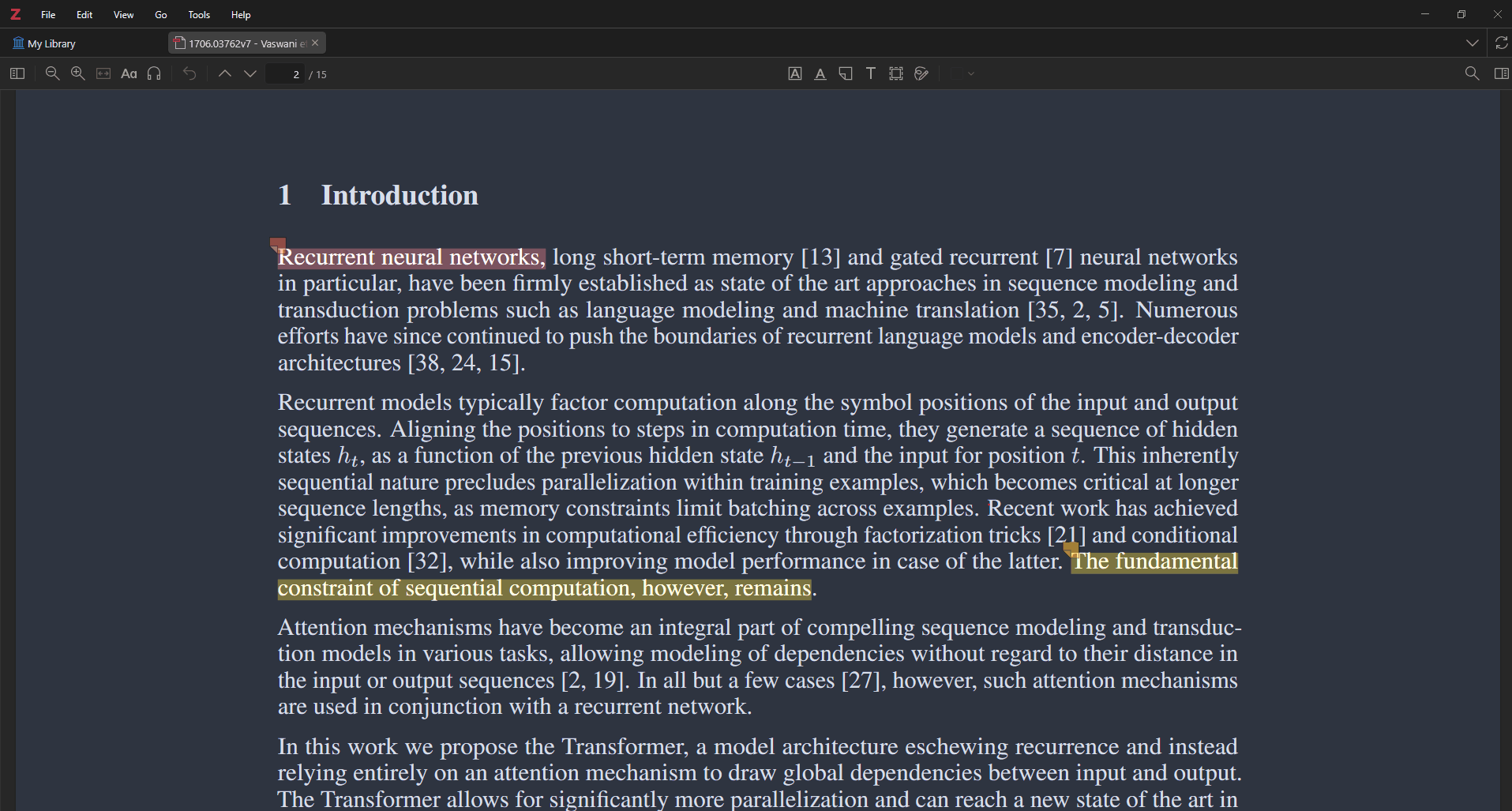
Where every literature note starts: highlights and a marginal comment in the PDF reader. This is capture, not a note — the fifteen minutes of translation described above is what turns this raw material into the worked example.
The template
Paste this into your notes app; adapt the fields, not the structure.
# {firstauthor}-{year}-{slug}

Source: {full citation}
Status: unprocessed / processed
Cite for: {2–4 keywords: what would send you back to this note}

## Claim
{Their central assertion, in your words, as a proposition.}

## Evidence
{The 1–3 results that carry the claim, with numbers and locators.}

## Method
{Who, what task, what comparison. Two sentences.}

## Limitation
{The reviewer-2 objection. What wouldn't you build on?}

## Connections
{Links to your notes, projects, and open questions. Minimum one —
if you can't write one, ask why you read the paper.}
The Cite for line deserves defense: it’s retrieval bait. When you search your notes in a year, you’ll search for the concept you need, not the paper’s title. Writing those keywords at processing time is you doing your future search a favor.
How long should a literature note be?
Between 150 and 400 words for most papers. Shorter and you’ve written a summary of a summary; longer and you’ve started transcribing. Two legitimate exceptions: a methods paper you’ll implement deserves more detail on procedure, and a paper central to your dissertation can run over a thousand words — but if every note is that long, the length has stopped encoding importance.
A useful calibration: the note should take 10–20% of the time the reading took. A three-hour close read earns a twenty-to-thirty-minute note. A fifteen-minute skim earns three lines — claim, one result, one connection — and that’s a complete literature note for a paper at that depth. Matching note effort to paper importance is the skill.
Processing cadence: why unprocessed highlights rot
Highlights decay because their meaning lives in your working memory, not on the page. The highlight marks what; the why — the connection to your project that made you reach for the highlighter — evaporates within days. Re-reading a three-week-old highlighted PDF, you’ll find yourself genuinely puzzled by half your own markings. The information wasn’t stored; it was leased.
The fix is cadence, not heroics: process highlights into literature notes within 48 hours of reading, and cap your reading intake to what you can process. This is the uncomfortable arithmetic — if you can process three papers a week, reading ten a week isn’t productivity, it’s a backlog with a feeling of progress attached. A weekly 90-minute processing block, calendared like a meeting, handles a normal reading load. The full capture-to-processing pipeline is laid out in the researcher note-taking system.
Where these notes live relative to your reference manager
The reference manager (Zotero, for most academics) owns metadata, PDFs, and in-document annotations. Literature notes belong outside it, in your note system, for one reason: connections. A note in Zotero can’t link to your chapter draft, your other notes, or your open questions — and connection is the field doing most of the work.
The clean division: highlight and annotate in Zotero’s PDF reader while reading, then pull those annotations into your note app as raw material and write the literature note around them. With Obsidian, the Zotero Integration plugin automates the pull — templated import of every highlight, linked back to the PDF page — which is covered step-by-step in the Zotero-Obsidian workflow. Keep the citekey (kahneman-1979-...) as the note’s filename and the two systems stay joined at the identifier without either owning the other.
The two mistakes that kill most systems
Transcribing instead of translating
The most common failure: literature notes that are quotes with the serial numbers filed off. Copying “the value function is (i) defined on deviations from the reference point” into your note is transcription — cheap to produce, worthless to reuse, because no thinking happened. The test is brutal and simple: close the PDF before writing the claim. If you can’t state it with the source hidden, you haven’t understood it yet, and the note would only have laundered that fact. Translation into your own words isn’t a stylistic preference; it’s the comprehension check and the retention mechanism, and it’s the entire price of a note that works later. Quotes are allowed — sparingly, marked as quotes, for wording you may want verbatim.
Over-noting
The opposite failure: notes so thorough they compete with the paper. If your note on a twenty-page paper runs to fifteen hundred words with figure-by-figure commentary, you’ve built a system whose cost guarantees abandonment — usually in week six, quietly. Completeness feels virtuous but it’s a form of not deciding what matters. The note’s job is to record your extraction from the paper, and extraction means leaving most of the ore in the ground. When something you didn’t note turns out to matter later, the PDF still exists; you’ll read it again with a better question. That’s not a system failure. That’s how reading works.
Write the next note, not the perfect one. A hundred adequate literature notes beat ten beautiful ones and ninety highlighted PDFs — and after the first month, the difference shows up where it counts: in how fast the first draft comes.